
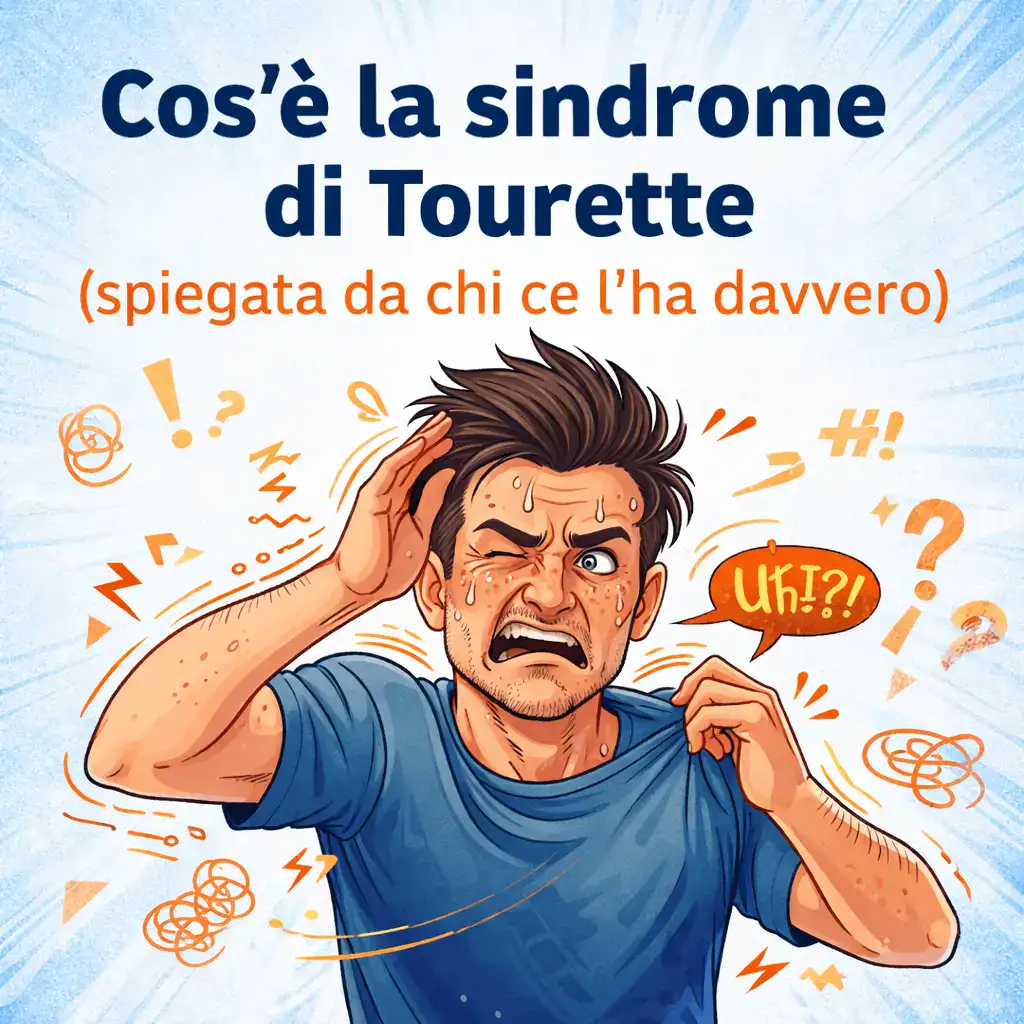
What Is Tourette Syndrome: A Simple Explanation
What is Tourette syndrome (simple explanation)
What is Tourette syndrome? If you’re looking for a medical definition, you can find it in two seconds on Wikipedia. If you want to understand what it actually feels like to live with it… stay here.
Imagine your body as a slightly rebellious radio. Most of the time, you choose the station. But sometimes, without warning, it switches channel, turns the volume up, or lands on static that you can’t ignore. Those interruptions are called tics.
It’s like when you feel a strong tickle in your nose and you have to sneeze. You can try to hold it back, but eventually it comes out. With Tourette’s, certain muscles or sounds do the same thing. Eyes blink, shoulders jump, sounds come out. Not because you want to. Not because you’re distracted. It just happens.
And the most important thing to understand is this: Tourette’s has nothing to do with intelligence or personality. It’s just a louder, more unpredictable way for the brain to communicate with the body.
What is Tourette syndrome from a medical perspective
From a medical point of view, Tourette syndrome is a neurodevelopmental disorder. It involves areas of the brain like the basal ganglia, which act like a traffic controller for movement.
In people with Tourette’s, that control system occasionally lets extra signals pass through. Those signals become tics.
There are two main types:
- Motor tics: physical movements like blinking, shrugging, head jerks
- Vocal tics: sounds like throat clearing, sniffing, or words
Before a tic happens, many people feel something called a premonitory urge. It’s like an internal pressure or itch that only goes away after the tic is released.
In simple terms, the brain builds up energy… and the body releases it.
How Tourette syndrome shows up in real life
Tourette’s is not constant. It doesn’t work like an on/off switch. It’s closer to the weather.
Some days are calm. Others are chaotic.
There are a few patterns that matter:
Premonitory urge
Before the tic, there’s a physical sensation that builds up. You can delay it, but not forever.
Waxing and waning
Tics come and go in waves. Weeks of calm can be followed by periods where everything increases.
Changing tics
They don’t stay the same. A cough can become a neck movement. One disappears, another takes its place.
Holding in
Many people suppress tics in public. But that comes at a cost. Once they feel safe again, everything comes out at once.
Comorbidities
Tourette’s often comes with other conditions like ADHD or OCD traits. Not always, but often enough to matter.
Living with Tourette’s means managing a body that doesn’t always follow your timing.
Tics explained: what they are and how they change
Tics are the most visible part of Tourette’s, but also the most misunderstood.
A simple way to describe them is this: they’re like muscle sneezes. Sudden, hard to stop, and followed by relief.
They are semi-involuntary. You can sometimes delay them, but you can’t cancel them completely.
What makes them unique is how they change:
- They come in waves
- They evolve over time
- They react to stress, fatigue, or emotions
Focus can reduce them. Stress can amplify them. But they never fully disappear just because you “try harder”.
Tourette syndrome myths (what the internet gets wrong)
The internet is full of misinformation about Tourette’s. Some of it is ridiculous. Some of it is damaging.
Here are the biggest ones:
“People with Tourette’s swear all the time”
Coprolalia exists, but it affects a small percentage. Most people have simple motor or vocal tics.
“It’s a mental illness”
It’s neurological, not psychological. It has nothing to do with intelligence.
“You can just control it”
Try not blinking for minutes. You can delay it, but eventually your body wins. Same thing.
“It’s caused by parenting or screens”
No. It’s biological. You’re born with it.
If something you read makes Tourette’s sound extreme, ridiculous or fake, it probably is.
My experience with Tourette syndrome
My experience is only one version of Tourette’s. There are people dealing with much heavier situations.
Did I struggle? Of course. Everyone does.
Back then, diagnosis didn’t come early. Mine arrived when Tourette Plus hit hard. That’s a completely different level.
At some point, though, you learn something important.You either fight it forever, or you start accepting it. At some point, you decide who stays in your life, shape your environment, and stop trying to fit into everything.
And eventually, you learn to live with it.
Conclusion: what you should really understand
Tourette’s is not something to “fix”. It’s something to understand.
Three things matter more than anything else:
1. The tic is only the surface
Behind it, there’s effort, control, and constant management.
2. Different doesn’t mean broken
It means a different system. Sometimes more chaotic, often more creative.
3. Normality helps more than pity
What makes the difference is how people react. Not the tic itself.
Understanding Tourette’s means understanding that everyone has something. Some people stutter, others freeze, and some tic.
Different rhythm. Same world.
Frequently asked questions about Tourette syndrome
Is Tourette syndrome serious?
It depends. In most cases, people learn to manage it over time.
Is Tourette’s a mental illness?
No. It’s neurological.
Can Tourette’s be cured?
No definitive cure, but symptoms often improve.
Can tics be controlled?
Only temporarily, and it requires a lot of energy.
If you liked this article, you might like this one too.


